
DIAMONDTRACK is a reusable track out mat with a staggered diamond pattern that deforms tyres and knocks mud and gravel loose before vehicles reach the road. Compared with rubber mats, RubberForm, FODS, rumble grids and ballast, it needs no excavation, sits on soft ground instead of pushing into it, and can be cleaned and moved from site to site.

Key takeaways
- Each mat is 2.13 m × 3.66 m and weighs 197 kg, so it’s far less likely to push into soft ground than heavier rubber mats.
- A straight exit needs at least two mats. The more complete wheel rotations a tyre makes on the mats, the cleaner it leaves.
- There’s no excavation. The mats sit on the surface, while a fixed rumble grid needs a dug-out area.
- Ballast is effectively single use once it clogs. DIAMONDTRACK is cleaned with a shovel, or flipped with a sling or forks, and reused.
- The staggered pattern means wheels on the same axle don’t all hit and drop off at once, so loaded trucks get a smoother ride than on straight-row lug mats.
- Each mat is rated to 800 PSI on flat, solid ground, and new mats are made from modified HDPE with up to 50% recycled content.
Key terms
- Track-out (also track out or trackout)
- Mud, gravel and debris carried off a site on vehicle tyres and onto public roads.
- Rumble grid
- A ribbed grid at a site exit that shakes debris off tyres. Traditional versions are installed into an excavated area.
- Ballast (rock exit)
- A bed of crushed rock at a site exit that scrubs tyres. It clogs with sediment and has to be dug out and replaced.
- Tyre deformation
- Making the tread flex as it rolls over raised shapes, so packed mud and gravel break loose.
- Modified HDPE
- The modified high-density polyethylene DIAMONDTRACK mats are made from. It’s fully recyclable.
Keeping mud, gravel, and site debris off public roads sounds simple enough. In practice, it rarely is.
That’s because track-out control only works when the system keeps working day after day, under traffic, in rough weather, and without turning into another problem for the crew to manage. Plenty of alternatives look fine on paper. Some even do a decent job for a while. But once you factor in cost, movement, clean-out, reusability, and real site conditions, the gap starts to show.
That’s where DIAMONDTRACK stands out.
Built as a reliable, reusable track-out mat, DIAMONDTRACK gives contractors a practical alternative to traditional rock exits, fixed rumble grids, and other mat systems that can be harder to justify once the job is underway. It’s not just about getting vehicles over the exit point. It’s about removing debris before it leaves the site, keeping roads cleaner, and not turning into a fresh headache for the crew.
First things first: what makes DIAMONDTRACK different?
DIAMONDTRACK is designed around a distinctive diamond-shaped profile that actively deforms tyres as vehicles pass over it. That matters.
Why? Because effective track-out control depends on dislodging mud, dirt, and loose material before it leaves the site. If the surface pattern doesn’t work hard enough, tyres carry debris straight out onto the road. And once that starts happening, everyone notices.
The diagonal diamond pattern on DIAMONDTRACK helps knock debris free more effectively than flatter or less aggressive surface designs. It’s a simple idea, really, but it makes a big difference on active construction exits where vehicles are constantly coming and going.

Just as important, the mats are quick to install, easy to relocate, and reusable from site to site. That combination is a big deal. A lot of alternatives can do one or two of those things. Not many do all three well.
Do rubber and plastic trackout mats do the job?
Let’s start with one of the more common alternatives, rubber or plastic-style mats.
On the surface, they can seem like a reasonable option. But on busy sites, especially where ground conditions are soft or uneven, they often create their own problems. Rubber mats can be pushed down into the ground over time, and once that happens, they start behaving less like a debris-control solution and more like a speed bump. Not ideal.
They can also sink, flex too much, or allow debris to fall through depending on the design. That last point matters more than people sometimes think. If the bottom isn’t solid, you’re not really controlling the debris. You’re just shifting where it ends up.
DIAMONDTRACK has a solid base, so debris can’t simply drop through the mat and build up underneath in the same way. It stays where it can be managed and cleaned. That makes the system more predictable, and honestly, that’s what site teams want. Predictable gear. Gear that does the job without needing constant babysitting.
It also comes in lighter and more cost-effective than some rubber-based alternatives, which is another tick in its favour when you’re balancing performance against budget.
How does DIAMONDTRACK compare with RubberForm?
One specific name worth covering is RubberForm. The first thing you notice is the weight. These are heavy mats, which on firm, well-compacted ground isn’t necessarily a problem. On softer surfaces it becomes one fast. The mat starts pushing down into the ground rather than sitting on top of it, and you’re back to the same issue we just covered.
The bigger issue is the ride. RubberForm uses a lug design where the raised sections sit in straight rows rather than staggered. That sounds like a minor detail. It’s not, once a fully loaded truck starts rolling over it. Every wheel on the same axle hits a lug at the same time and drops off at the same time, creating a hammer-like rhythm that’s brutal in the cab.
Drivers don’t like it. Cab suspension doesn’t like it either. Over enough passes you start hearing about it from operators, and across the life of a long job that adds up in driver comfort and in cab repairs down the track.
DIAMONDTRACK avoids both problems. The mats are lighter, so they’re far less likely to push into soft ground. And the diamond pattern is staggered, not straight, so as wheels move across, the contact points alternate rather than landing all at once. That’s still doing the work of dislodging mud and debris, but without punishing the truck and the driver every time.
What’s the difference between FODS and DIAMONDTRACK?
This comparison is probably the most relevant for many sites because FODS is already a familiar option in the market.
And to be fair, it sits in the same general category. Similar size. Similar material. Similar purpose.
But the key difference is the pattern, and that’s not a small detail. It’s the whole game.
DIAMONDTRACK uses a diagonal diamond profile designed to deform tyres and dislodge debris more effectively. That pattern works with the tyre path rather than just sitting under it. So instead of relying on vehicles to roll over a surface that may only partially disturb the tread, DIAMONDTRACK creates more active contact that helps shake off mud and sediment before it reaches the road.
That’s the bit worth focusing on. Because in track-out control, “pretty close” isn’t always close enough.
Then there’s the cost side. DIAMONDTRACK is also a more cost-effective solution, which makes it easier to roll out across projects without compromising on performance. So you’re not just getting a mat that works well. You’re getting one that stacks up commercially too.
What about rumble grids and ballast?
This is where the comparison gets even clearer.
Traditional rumble grids can be effective, but they usually require excavation. That means digging out an area, fitting the grid in place, and committing to a fixed setup. It’s a bigger install with more site disruption, and far less flexibility if access changes or the job moves along.
DIAMONDTRACK skips all that. No excavation. No hole in the ground. No drawn-out install. You lay it down, use it, clean it, and move it when needed. For contractors working across changing site conditions or multiple locations, that flexibility matters. A lot.

Then there’s ballast. Yes, a ballast track can serve a purpose, but it’s typically single use. Once it clogs up with sediment and debris, it loses effectiveness and has to be removed and disposed of. That means more waste, more trucks in and out, and a recurring cost in replacement material.
DIAMONDTRACK, by contrast, is reusable and easy to clean. That’s better for the site budget and better from an environmental point of view too. You’re not sending loads of contaminated rock to landfill every time performance drops off.
| Option | What to watch for | DIAMONDTRACK |
|---|---|---|
| Rubber or plastic mats | Can be pushed into soft or uneven ground and end up acting like a speed bump. Some designs let debris fall through. | Solid base, so debris stays on top where it can be cleaned. |
| RubberForm | Heavy, so it pushes into soft ground. Lugs sit in straight rows, which hammers the cab of loaded trucks. | Lighter, with a staggered pattern so contact points alternate. |
| FODS | Similar size, material and purpose, with a less aggressive surface pattern. | Diagonal diamond profile deforms tyres more actively, and it’s more cost-effective. |
| Rumble grids | Need excavation and a fixed setup, so there’s little flexibility if access changes. | No excavation. Lay it down, clean it and move it. |
| Ballast (rock exit) | Single use once it clogs. It has to be removed, disposed of and replaced. | Reusable and quick to clean. |
The real question is: what holds up over time?
That’s usually what this comes down to.
Not what looks okay on day one. Not what’s cheapest if you ignore labour, waste, and replacement. What actually holds up.
DIAMONDTRACK is built around that question. The diamond pattern cleans tyres properly. It doesn’t sink on soft ground or pound the cab on every pass. And when the job changes, you lift it and move it. No excavation to undo, no rock to dispose of.
And that’s why it makes sense on real jobs. Busy jobs. Muddy jobs. The kind where things don’t stay neat for long.
If you’re weighing track-out control options for an active site, the easiest next step is a conversation. We can run through your site conditions, the sort of vehicles coming in and out, and which size of DIAMONDTRACK fits the way the job actually runs.
From the job: Level Crossing Removal, VIC

- Where
- Melbourne, VIC. A major level crossing removal project run by a Tier 1 civil contractor.
- What was needed
- Heavy construction vehicles were moving in and out all day, carrying mud, gravel and loose debris onto busy public roads. The contractor needed track-out control that was quick to deploy and tough enough for daily traffic.
- What we did
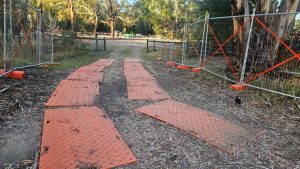
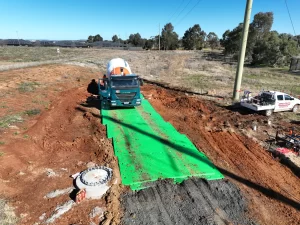
- We supplied DIAMONDTRACK mats for the site exit. They went down with no excavation, and the diamond profile deformed tyres to shake sediment and gravel loose before vehicles left the site.
- How it turned out
- The contractor had cleaner access points and less material reaching surrounding roads. The mats were easy to clean under constant traffic, and they can be lifted and reused on future projects.

Mistakes and exceptions
Using a single mat. A straight exit needs at least two DIAMONDTRACK mats. Tyres need several complete rotations on the mats to clear properly, and the more rotations you get, the cleaner they leave.
Letting the mats fill up. Once debris packs in between the diamonds, the mats stop cleaning tyres properly. Clear them with our custom shovel, or lift them with a sling or forks and flip them over, and they’re back to original performance.
Expecting the full load rating on any surface. The 800 PSI rating applies when the mats sit on flat, solid ground.
Not planning for unloading. The mats arrive on a pallet by truck, so you’ll need a forklift or a machine with forks on site.
Exception: firm, compacted ground. Heavier mats such as RubberForm aren’t necessarily a problem on firm, well-compacted ground. Their weight becomes an issue on softer surfaces, where they push down instead of sitting on top.
Exception: an exit that won’t move. Rumble grids can be effective. The trade-off is excavation and a fixed setup, so they make the most sense where the access point stays put for the whole job.

 Quick Quote
 Ask a Specialist